• Recent indicators show the Selic at 13.75%, GDP up 0.5% in the second quarter, and a drop in consumer and business confidence measured by FGV. • The Economic Uncertainty Indicator (IIE-Br) fell to 110.8 points in September 2026, but remains at a level classified as high. • There is a distinction between risk, which allows for calculating probabilities, and uncertainty, where data is lacking to determine the outcome with precision. • In unpredictable scenarios, flexibility, preserving alternatives, and weighing the cost of acting versus waiting gain value. • Making sound decisions does not require predicting the future with exactness, but focusing on controllable variables and designing scenarios for different possibilities.
Making decisions has never been an easy task. But there are moments when deciding seems even harder: when the present provides enough information to show that something is changing, but the future does not yet allow us to know exactly where it is heading.
It is in this environment that people and companies must keep making decisions.
To buy or not to buy. To hire or to wait. To invest or to preserve cash. To change jobs or stay put. To expand an operation or postpone the project. To take out financing or wait for better conditions.
These decisions happen every day, but they are not made in a vacuum. They are influenced by the economic environment, by expectations, and by the perception that each person or organization builds about the future.
In Brazil, the most recent data points to a scenario that deserves attention.
In September 2026, the Monetary Policy Committee (Copom) reduced the Selic rate to 13.75% per year. In the same decision, Banco Central stated that economic activity was showing a gradual moderation, although remaining resilient, and that the labor market remained heated. The monetary authority also noted that inflation expectations for 2026 and 2027 stood at 4.9% and 4.3%, respectively, above the inflation target.
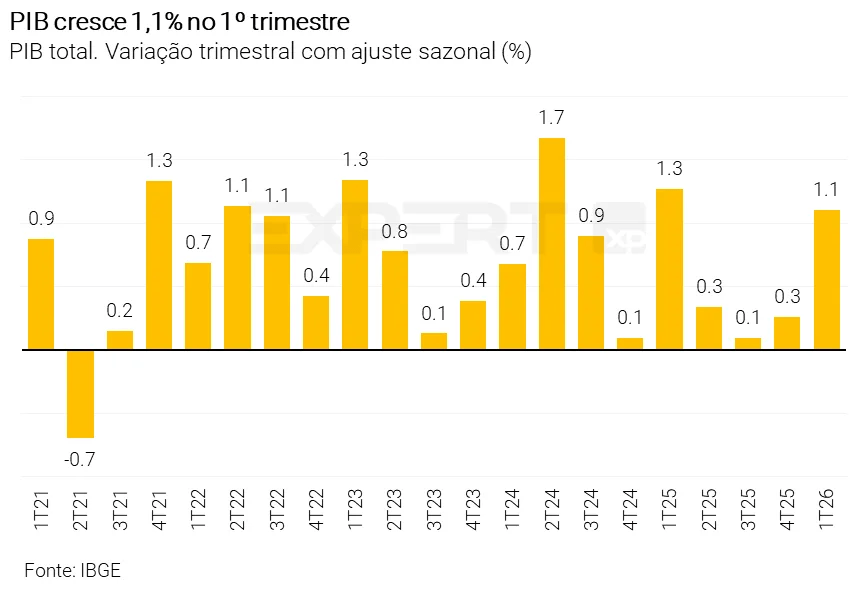
At the same time, Brazilian Gross Domestic Product (GDP) grew 0.5% in the second quarter of 2026 compared to the first quarter, after having advanced 1.1% in the first quarter. Over the four quarters ending in the second quarter, growth was 1.9%.
Inflation also painted a picture different from what often appears in an isolated headline. The IPCA accumulated 4.22% in the 12 months through August 2026, while the index's monthly change was -0.32%.
/i.s3.glbimg.com/v1/AUTH_59edd422c0c84a879bd37670ae4f538a/internal_photos/bs/2026/d/b/x0ZB3BRcac7SXfHc9IFQ/260911-grafico-ipca-inflacao-oficial-mes-a-mes.jpg)
And there is another particularly interesting indicator for understanding the current moment: the Economic Uncertainty Indicator (IIE-Br), calculated by Fundação Getulio Vargas.
In September, the indicator retreated 0.9 points, reaching 110.8 points. Even so, FGV itself classified the uncertainty as high.
These figures do not mean that the future will necessarily be better or worse.
They show something else: the environment in which people and companies are making decisions is complex and has different signals occurring at the same time.
When the economy stops being a distant subject
It is common to treat economic indicators as subjects restricted to economists, investors, governments, and large corporations.
“Yet the economy shows up in much simpler decisions.
A family evaluating financing is looking at interest rates.
A company that needs to buy machinery is looking at the cost of capital and demand.
A professional considering changing jobs is evaluating income, stability, and prospects.
An entrepreneur looking to open a new location needs to consider operating costs, consumer behavior, and credit conditions.
In other words, the economy is not just what appears in the newspapers.
“It is also the context in which we make choices.
When the Selic is at 13.75% per year, for instance, that does not mean everyone will pay that exact rate on a loan. The Selic is the economy's benchmark interest rate, and the rates actually charged to consumers and companies depend on several other factors.
Even so, the benchmark rate influences financial conditions throughout the economy.
Because of this, a shift in monetary policy can alter the environment in which households and businesses assess credit, consumption, and investment.
Banco Central, in fact, describes monetary policy as a mechanism that seeks to influence financial conditions and economic demand with the objective of guiding inflation toward the target.
The question, therefore, is not simply knowing whether interest rates went up or down.
It is understanding how economic conditions alter the room available to make decisions.
Uncertainty is different from risk

There is an important difference between risk and uncertainty.
In a risk situation, we can identify different possible outcomes and, under certain circumstances, estimate their probabilities.
Uncertainty, on the other hand, is associated with situations in which we do not have enough information to determine with precision what will happen.
In practice, business and personal decisions frequently contain both elements.
Imagine a company evaluating an investment of R$ 500,000.
It can estimate how much it expects to sell, how much it will need to spend, and what the expected return would be.
These elements can be modeled.
Yet some questions remain open:
What will demand look like a year from now?
What will costs look like?
What will credit look like?
Will there be regulatory changes?
How will competitors be doing?
The company cannot eliminate these questions.
It can, however, build scenarios.
This distinction is fundamental.
“Planning does not mean predicting the future perfectly. It means preparing for different possibilities.
What confidence indicators reveal
Confidence indicators help in understanding another component of this discussion: expectations.
In September 2026, the Consumer Confidence Index (ICC) from FGV IBRE fell 0.5 points, to 84.2 points, reaching its lowest level since November 2022. The decline was mainly driven by worsening expectations.
This data does not mean that every Brazilian is pessimistic.
A confidence index is an aggregate metric. It represents the behavior of a pool of survey respondents and does not allow for individual conclusions about what each person thinks or will do.
However, the indicator is relevant because it shows a measurable shift in the perception of surveyed consumers.
Business confidence also showed a decline.
In September, the Business Confidence Index (ICE) from FGV IBRE dropped 1.2 points, to 89.3 points.
Once again, interpreting it correctly is essential.
The indicator does not mean that all companies are cutting investments or hiring fewer people.
It indicates that, across the sample surveyed by FGV, business perception grew less favorable.
This difference between what the data measures and what we can conclude from it is fundamental.
Information overload can also be a problem
/i.s3.glbimg.com/v1/AUTH_59edd422c0c84a879bd37670ae4f538a/internal_photos/bs/2023/A/c/l3zR2YSJegEl0df3GV2Q/foto2-comunicacaopessoas.png)
There is a unique characteristic of our times: we have never had access to so much information.
In a matter of minutes, a person can track the Banco Central decision, inflation, financial markets, international news, political developments, and expert opinions.
This seems like an absolute advantage.
Yet information and knowledge are not the same thing.
Having access to more information does not guarantee a better decision.
A company can have hundreds of metrics on its dashboards and still not know what decision to make.
A person can follow dozens of economic news stories daily and still not know whether a given decision makes sense for their reality.
The question becomes:
Which information actually matters for the decision I need to make?
This is an increasingly vital skill.
It is not necessarily about consuming less information.
It is about learning to separate:
data from opinion; fact from interpretation; trend from isolated event; relevant information from information overload.
Uncertainty can alter behavior

When the future seems less predictable, one possibility is that people and organizations begin to place greater value on flexibility.
Instead of taking on commitments that are difficult to reverse, it may make sense to preserve alternatives.
A company may prefer to test a new operation before making a larger investment.
A professional may develop a new skill before leaving their current job.
A family may bolster its emergency fund before taking on long-term debt.
These are not universal rules.
They are potential behaviors in the face of environments where the future presents greater uncertainty.
And there is an important distinction: not acting is also a decision.
Waiting can carry a cost.
Acting can also carry a cost.
The challenge lies in comparing the two.
What is within our control?

It is precisely at this point that economics and personal development meet.
No individual controls inflation.
No business owner controls the Selic rate alone.
A company does not control the global landscape.
A professional does not control every shift in the labor market.
Yet there are variables that can be influenced.
A company can manage its costs better.
It can track its metrics.
It can better understand its customers.
It can create different financial scenarios.
It can develop its professionals.
It can improve its processes.
It can use data to reduce decisions based solely on perception.
An individual can develop new skills.
They can better organize their finances.
They can seek information from reliable sources.
They can evaluate different scenarios before making a decision.
They can identify which risks are truly within their control.
This distinction is important because uncertain environments can produce a sense of lack of control.
When everything seems unpredictable, there is a risk of focusing our attention precisely on what we cannot change.
An alternative is to invert the question.
Instead of only asking:
"What is going to happen?"
we can ask:
"What can I do in the face of different possibilities?"
The role of data in decision-making

Data does not eliminate uncertainty.
This is an important idea.
Even with good indicators, no one can predict the future perfectly.
The role of data is different: to improve the quality of decisions.
GDP provides a snapshot of economic activity in a given period.
The IPCA reflects price trends according to its methodology.
The Selic shows the benchmark rate set by Banco Central.
Confidence indicators show perceptions captured in surveys.
The IIE-Br seeks to measure economic uncertainty.
Each indicator answers a different question.
The mistake begins when we try to make a single indicator answer every question.
A company that tracks only revenue may fail to notice changes in customer acquisition cost.
A person who looks only at salary may overlook debt levels and cost of living.
A manager who looks only at productivity may fail to observe turnover and organizational climate.
Data must be connected to the question we want to answer.
Deciding without certainty
This is perhaps one of the core skills for individuals and companies in complex environments.
Deciding without certainty does not mean deciding irresponsibly.
It means recognizing that some decisions must be made before all information is available.
Banco Central does not wait to know the future with absolute certainty before making monetary policy decisions.
Companies cannot wait to know exactly how much they will sell over the next five years to start planning.
Individuals cannot know all the consequences of a career move before making it.
The decision takes place in the present.
The future comes afterward.
Therefore, a good decision should not be evaluated solely by the outcome that followed.
A decision may have been rational given the information available at the time and, even so, produce a result different from what was expected.
This point is especially important for leaders.
Leading in an environment of uncertainty does not mean projecting artificial certainties.
It means making clear what we already know, acknowledging what we do not yet know, setting priorities, and establishing how the organization will respond if conditions change.
The price of uncertainty

The latest data points to a scenario with multiple simultaneous elements.
The Selic is at 13.75% per year. [1]
GDP grew 0.5% in the second quarter of 2026 compared to the previous quarter. [2]
Cumulative 12-month IPCA through August stood at 4.22%. [3]
The Economic Uncertainty Indicator declined in September, but remained at an elevated level. [4]
Consumer confidence fell to 84.2 points. [5]
Business confidence also retreated. [6]
None of these data points, in isolation, determines what an individual or a company should do.
They help build the context.
And perhaps that is the main lesson.
Uncertainty does not mean an absence of information.
Sometimes, it means having enough information to realize that there are different possible paths.
It is in this scenario that critical thinking, data, and adaptability become vital.
The goal should not be to find someone capable of predicting the future perfectly.
It should be to develop individuals and organizations capable of making sound decisions even when the future remains partially unknown.
Because we cannot control all the factors that shape the economy.
We cannot control every political decision.
We cannot control every market movement.
But we can improve the way we interpret information, evaluate alternatives, and act upon them.
The future will remain uncertain. Our ability to make decisions does not have to be.
References
[1] Banco Central do Brasil — Communiqué No. 45,963, of September 16, 2026.
Copom decision on the Selic rate and assessment of the economic scenario.
[2] IBGE — Quarterly National Accounts System, Q2 2026.
Official data on Brazilian GDP.
[3] IBGE — IPCA / Inflation.
Official inflation data for August 2026.
[4] FGV IBRE — Economic Uncertainty Indicator (IIE-Br), September 2026.
Data on the evolution of economic uncertainty.
[5] FGV IBRE — Consumer Confidence Index (ICC), September 2026.
Data on consumer confidence.
[6] FGV IBRE — Business Confidence Index (ICE), September 2026.
Data on business confidence.

Read also
TURP Crisis Moves Beyond Transportation and Affects the Economy and Daily Life of Petrópolis Residents
By Thiago LealThe Danger Beside You: Why Brazil Still Relies So Heavily on Roads to Transport Fuel
By Thiago LealFrom Caution to a Vote: What Changed in Davi Alcolumbre’s Stance on the 6x1 Work Schedule?
By Thiago Leal0 comments
The author of the message, not Festina, is responsible for the comment. Read the Comment Guidelines.